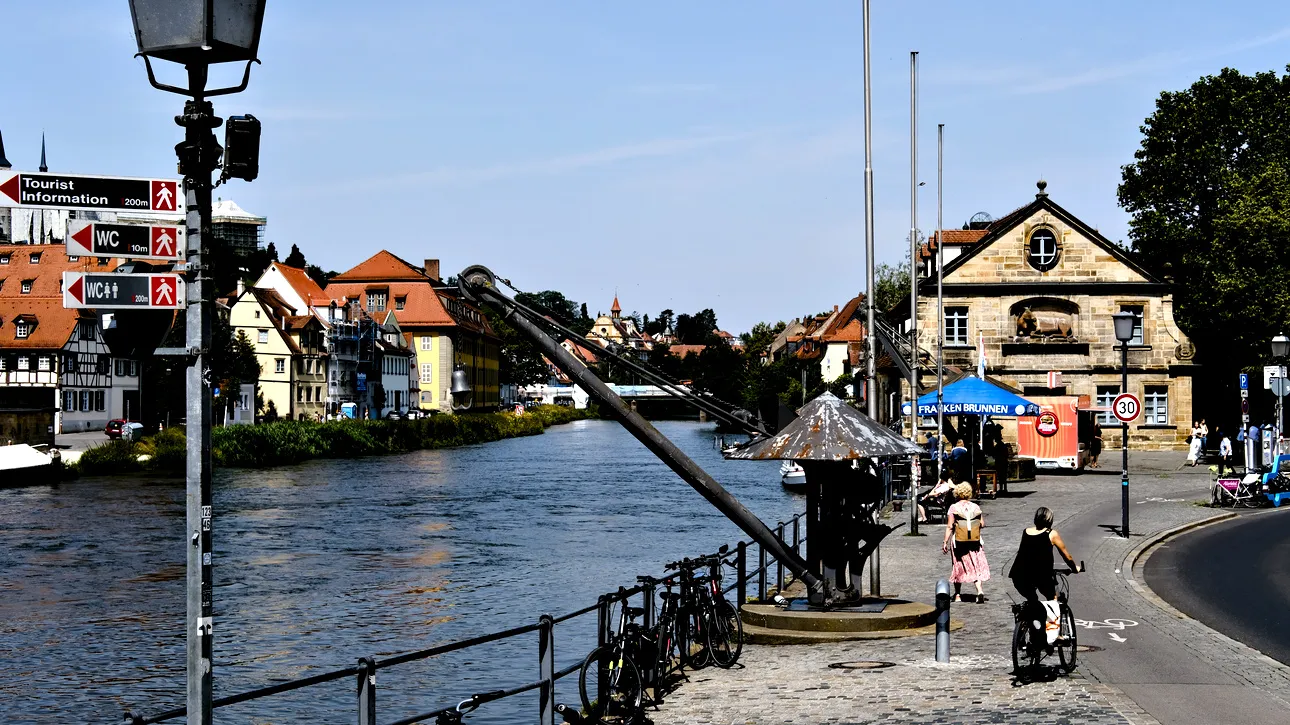
An den Kranen served for centuries as Bamberg's river harbor on the left arm of the Regnitz - within sight of the Old Town Hall. The name refers to the two cast‑iron swing cranes and the carefully dressed stone quay, the clearest remnants of this port function. In 1156, Emperor Frederick I Barbarossa granted Bamberg staple rights: passing vessels had to stop and offer their goods for three days, boosting trade and transshipment at this spot.
Highlights
- Two swing cranes: Not medieval - they were built for the Ludwig-Danube-Main Canal, one in 1849, the other in 1864, by Johann Wilhelm Spaeth; note the cast iron, jib and metal hood.
- Stone quay & harbor feel: The quay wall makes the site's former role as a traffic hub tangible.
- Views across the old town: Vistas to the Old Town Hall, cathedral towers and Michaelsberg Abbey.
- Former slaughterhouse: The 1741/42 slaughterhouse (gable with ox figure) stands right on the quay; today it's used by the University of Bamberg.
History at a glance
Documented as a berth and transshipment point since the late Middle Ages. The 1156 staple right obliged merchants to offer wares for three days. In the 19th century, with the Ludwig Canal (opened 1846), the current iron cranes were installed; Bamberg and Kelheim served as the termini. Cargo handling at the quay continued until 1912; later it shifted elsewhere. Today the quay is a viewpoint and excursion‑boat mooring.
Architecture & details
The swing cranes are working‑principle engineering monuments of the 19th century: cast‑iron structures with rotating jibs and protective sheet‑metal roofs. Together with the quay wall, they reconstruct the logistics choreography of docking, loading/unloading and short‑term storage. On the edge of the square, the former slaughterhouse (architect Paulus Mayer) extends with arcades down to the water; the ox in the gable signals its historic function. Today, like the opposite Hochzeitshaus (1610-1612), it's used by the University of Bamberg.
Plan your visit
- Location & access: Am Kranen, 96047 Bamberg - public riverside a few steps from the Old Town Hall.
- Best light: Early morning or late afternoon for photos along the river axis.
- On site today: Viewpoint with benches; excursion boats use the quay as a landing stage.
- Note: High water or events may temporarily restrict riverside access - follow local notices.
Nearby
- Old Town Hall - landmark on the Regnitz.
- Geyerswörth Palace - city palace on the island.
- Bamberg Cathedral - imperial cathedral with imperial and papal tombs.
- Michaelsberg Abbey - hilltop monastery with views.
- Little Venice - former fishermen's quarter.
About this page: Editorial overview of history, technology and visiting; based solely on the linked sources. Last reviewed: 03 Nov 2025.
Sources
- https://www.bambergguide.de/item/kranen/
- https://www.bayern-lese.de/sehenswuerdigkeiten/oertlichkeiten/am-kranen-bamberg/
- https://www.outdooractive.com/de/poi/steigerwald/-am-kranen-bamberg/61973951/
- https://www.stadt-land-erleben.de/bamberg/s15.htm
- https://pages.et4.de/de/sieben-fluesse-wanderweg/streaming/detail/POI/p_100076018/alter-hafen