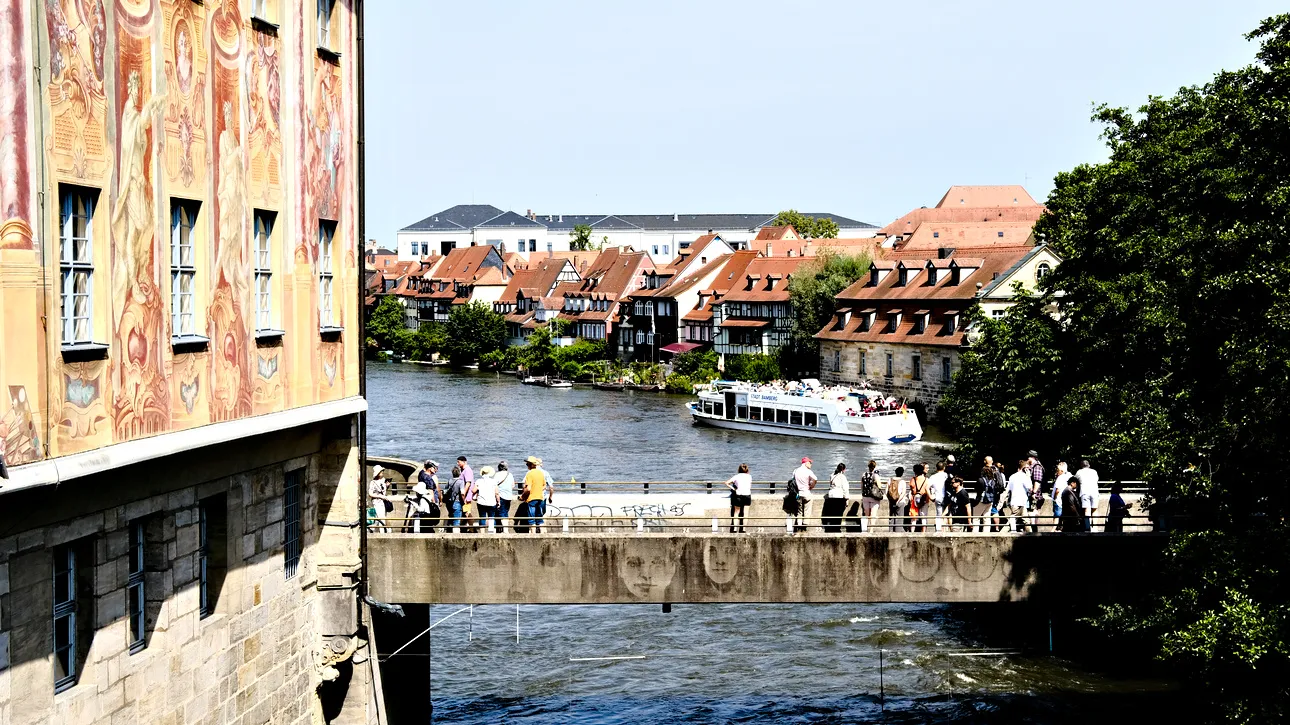
The Upper Bridge is Bamberg's oldest surviving bridge. It links the island city with the Domberg area, standing immediately beside the Old Town Hall, and is one of the most striking crossings over the Regnitz. The three‑arch stone bridge was built-apart from a later renewal of the central arch-between 1451 and 1456. [2] As early as 1367, two closely spaced bridges at this point are documented: the southern Upper and the northern Lower Bridge. [2]
Context & ensemble
The bridge carries the well‑known Town Hall ensemble, listed separately as "Obere Brücke 1 - Altes Rathaus". It is therefore inseparable from the city's representative architecture erected in the middle of the river. [3] On the monument portal, the Upper Bridge is also designated as part of the island city's World‑Heritage urban monument. [2]
Design & construction
The Upper Bridge has three arches. It was built to plans by Bamberg city master‑builder Hans Vorchheimer as a new stone structure, replacing an earlier bridge along the same line that already carried the town‑hall complex. [2] The structure survived the flood of 1784 with comparatively minor damage. [2]
Around 1900 the bridge was widened to accommodate tram tracks. [2] Wartime demolitions in 1945 destroyed the central arch directly adjoining the town hall; it was rebuilt as a concrete arch and clad in sandstone, preserving the appearance of a historic stone bridge. [2]
Sculpture on the bridge
The Crucifixion group bears the date 1713 and is attributed to the sculptor Johann Leonhard Gollwitzer. Its endowment goes back to the merchant Johann Franz Cache (Obere Brücke 3) in 1628. [2] The iconography is clear: Mary Magdalene kneels at the foot of the Crucified; to his right stands Mary, to his left the Evangelist John. In pedestal niches sit the evangelists Luke, Matthew and Mark. [2]
Opposite the Crucifixion stands the statue of St John Nepomuk, made by Johann Caspar Metzner in the early 18th century. This figure was replaced in 1926 by a copy by Hans Leitherer; the original belongs to the collections of the Historical Association of Bamberg. [2]
Timeline
- 1367: Two bridges attested here (Upper and Lower Bridge). [2]
- 1451-1456: Construction of the three‑arch stone bridge to plans by Hans Vorchheimer, replacing an older crossing that already carried the town hall. [2]
- 1784: Flood with only minor damage to the bridge. [2]
- c. 1900: Widening to carry tram tracks. [2]
- 1945: Destruction of the central arch by bridge demolitions. [2]
- Post‑1945: Reconstruction of the central arch as a concrete arch, sandstone‑clad. [2]
- 1713 / 1926: Crucifixion group (attrib. Gollwitzer) and Nepomuk (Metzner; copy by Leitherer) still define the bridge; the original Nepomuk is held by the Historical Association. [2]
Relation to the Old Town Hall
The Old Town Hall with bridge tower, main building and Rottmeisterhäuschen is listed separately at Obere Brücke 1. Its oldest parts date to the early 14th century; today's appearance results from 18th‑century Baroquisation. [3] The immediate proximity explains why interventions on the bridge-such as the 1945 demolitions-also affected the Rottmeisterhäuschen. [3]
Visitor tips
The Upper Bridge is a public crossing in the historic centre; the sculpture and sightlines are best appreciated in situ. Pay attention to the space around the town hall and take a counter‑view towards the Lower Bridge to grasp the historic double crossing of the Regnitz. [2][3]
Nearby
- Old Town Hall - Landmark on the bridge
- Saint Kunigunde - Empress and patron of Bamberg
- An den Kranen - Old harbour & river views
About this page: Summary based on the linked monument entries of Schutzgemeinschaft Alt Bamberg e.V. and the City of Bamberg. Last reviewed 2025-11-04.