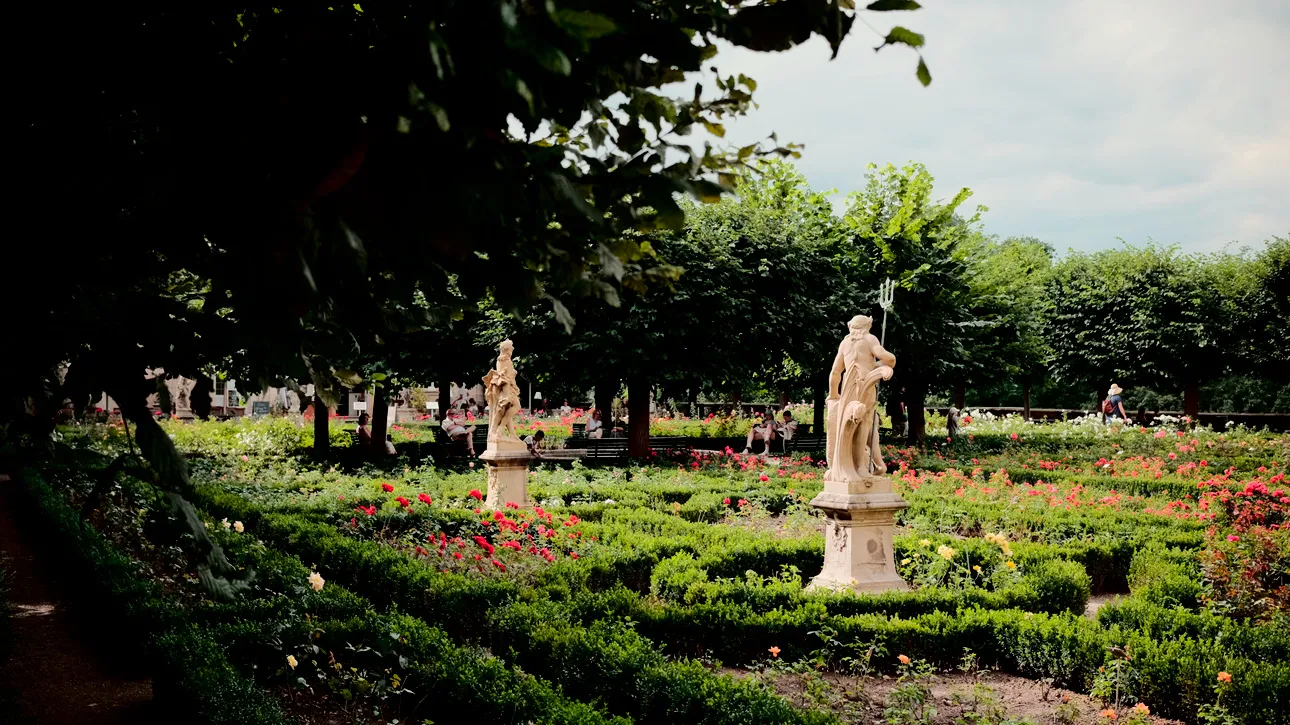
The Rose Garden is a Baroque garden behind the New Residence on the Domberg-a green terrace with far‑reaching views over roofs, towers and the Regnitz valley. Its design is easy to read: a central cross‑axis organizes the beds, a round fountain sits at the intersection, and trimmed lime trees frame the layout. In summer, around 4,500 roses in over 70 beds are in bloom. [1][3]
Highlights
- City views: The elevated site makes the Rose Garden one of Bamberg's favourite viewpoints. [1]
- Baroque order: Cross‑axis, fountain, box‑edged beds and lime trees create a calm, clear scene. [1][3]
- 1757 pavilion: The delicate garden pavilion adds a Rococo accent on the main axis. [1][3]
- Sculptures by Ferdinand Tietz (1760-1761): Mythological figures enliven beds and paths. [3]
- Memorial to Otto of Greece and Amalie: A stone with Greek and German inscription recalls residents of the Residence. [3]
History in brief
A Renaissance garden preceded today's layout in the 16th century. In 1733 Prince‑Bishop Friedrich Carl von Schönborn ordered a Baroque redesign; Balthasar Neumann provided the design. The pavilion is by Johann Jakob Michael Küchel (1757) and gives a light Rococo finish towards the wall. In 1760-1761 Ferdinand Tietz added the sculptures, completing the program. [3]
The present clarity of form-axes, fountain, hedges and tree frame-reflects Baroque ideals of order and sightlines, while the garden enters into dialogue with the city: views run across the Domberg to cathedral, old town and river landscape. [1][3]
Design & details
On entry you experience symmetry without severity. The cross‑axis sets an unhurried walking pace; the fountain marks a midpoint to pause. Box edging structures the rose beds, whose summer variety creates a dense carpet of colour and scent. [1][3]
Trimmed lime trees provide a green backdrop and define garden rooms. In the contrast between natural forms (roses, foliage) and architectural motifs (edgings, pavilion, balustrades) the Baroque play of order and ornament appears. [1][3]
Between the beds stand mythological sculptures by Ferdinand Tietz (1760-1761), adding a theatrical note without disturbing the quiet. A special feature is the memorial to King Otto of Greece and Queen Amalie, with a bilingual inscription that points to 19th‑century Residence history. [3]
The garden pavilion (1757) by Küchel provides a cheerful Rococo accent. From here, perspective and proportion feel especially balanced; small changes of position along the paths shift perception in subtle ways. [1][3]
Plan your visit
- Address & location: Domplatz 8, 96049 Bamberg-in the courtyard of the New Residence on the Domberg. [1]
- Current info: For opening times, closures, accessibility and rules, see the official page of the Bavarian Palace Department and the garden page of the New Residence:
- Rose Garden - Bavarian Palace Department [1]
- Rose Garden - New Residence Bamberg [2] - Etiquette & use: Please follow garden regulations; this listed site has clear rules (stay on paths, protect beds, observe on‑site notices). [2]
- Photo tip: From the terrace edge you'll get wide panoramas-especially atmospheric in late afternoon. [1][4]
Nearby
- New Residence - prince‑bishops' palace with State Gallery. [1]
- Bamberg Cathedral - the imperial cathedral on the Domberg.
- Old Court - Renaissance courtyard on Cathedral Square.
- Historical Museum - city & cultural history on the Domberg.
About this page: Editorial overview based on official/authoritative sources only. Last reviewed {today}.