Geyerswörth Palace is the former prince-bishops' city palace in Bamberg's old town, named after the Nuremberg Geyer family. As the bishops' town residence it shaped the rulers' presence before the Neue Residenz on the Cathedral Hill became the main address. The complex sits scenically on a river island between the left branch of the Regnitz and the Nonnengraben, tightly interwoven with the island city's waterscape. [1][4]
Highlights at a glance
- Renaissance palace ensemble: The present form goes back to remodelling under Prince-Bishop Ernst von Mengersdorf; the configuration was essentially achieved in the late 1580s (1588/89). [1][3]
- Prince-bishops' town residence: Until the expansion of the Neue Residenz, Geyerswörth served as the key urban seat; a fountain coat of arms in the court refers to Marquard Sebastian Schenk von Stauffenberg. [1]
- Island setting: The property occupies the northern part of a peninsula between the Regnitz branch and the Nonnengraben-an urban ensemble of water, courts and lanes. [4]
- Renaissance Hall & courts: Inside, the Renaissance Hall is one of the city's representative rooms; the double-courtyard layout illustrates how functions grade from outer to inner space. [3]
History in brief
The Geyer family built a city palace here in 1313, giving name to place and palace. During the 16th century the property gradually passed to the Prince-Bishopric of Bamberg; after 1585/86 Prince-Bishop Ernst von Mengersdorf ordered its conversion into a Renaissance palace. [1] The shape perceived today was largely in place by 1588/89. [3]
As the town seat of the prince-bishops, Geyerswörth shaped the sovereigns' urban representation. A park south of the palace-now vanished-goes back to Johann Georg I. Zobel von Giebelstadt; only a former gardener's house survives. [1] After major projects on the Cathedral Hill were completed, the palace was used mainly for administration. [1]
A major turning point came in the 18th century: after the collapse of the two Renaissance gables on the north side in the 1740s, the palace received its current appearance. [1] Today the complex houses City of Bamberg offices. [1]
Architecture, setting & ensemble
Geyerswörth is a multi-part complex with Renaissance façades, a tower roof and two courtyards. Its island location is distinctive: between the Regnitz branch and the Nonnengraben (backwater/canal) unfolds a tight fabric of bridges, banks and lanes binding court and city spaces. [4] The historic Renaissance Hall embodies the representative functions; at the same time, administrative use has shaped the place for centuries. [1][3]
Subtle shifts of scale-the narrow lanes, the open courts, the nearby water-create changing sightlines. Take time to spot traces of different building phases, adaptations for administration and the recent restoration work on façades, roofs and interiors. [3]
Use today & restoration
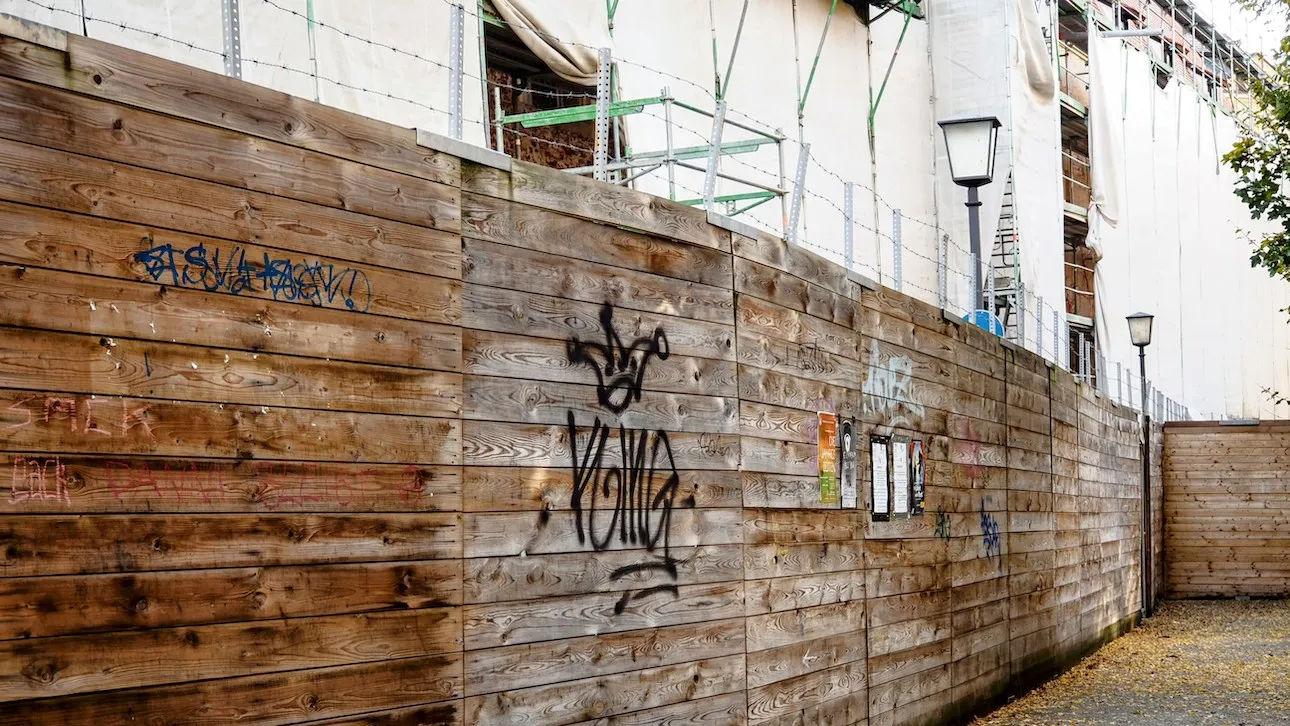
The Geyerswörth Palace complex (city hall) is undergoing comprehensive restoration and modernisation. Plans include roof structures and coverings, interior alterations, ceiling and façade repairs, and full renewal of building services. Fire safety and accessibility follow current standards. [3]
Since 2024 the Baroque wing has been restored separately. It will host administrative offices; in the western part the Bamberg Marionette Theatre will receive new performance rooms. [3] This reflects the dual role as administrative site and public cultural venue.
Only fragments of the once sumptuous interiors survive; parts of the Renaissance Hall have been restored. [2] Together with the courtyard and façade design this still conveys a vivid sense of former representation.
Plan your visit
- Address & location: Geyerswörthstraße 3, 96047 Bamberg. Coordinates approx. 49.891158 N, 10.887839 E-in the island city between the Regnitz branch and the Nonnengraben. [5][1][4]
- Access: During restoration access to courts and interiors may be restricted. Please check works status and potential closures via the linked city/project pages. [3]
- Culture: The courtyard has repeatedly served as an atmospheric venue (e.g. Franconian Summer Theatre). See organisers for details and dates. [6]
- Photo tip: Exterior views work well from the riverbank; short perspective shifts along the bridges emphasise façade and tower proportions.
Nearby
- Old Town Hall - landmark straddling the bridge.
- An den Kranen - historic harbour square.
- Obere Brücke - stone bridge with Crucifixion group.
- Klein Venedig - riverside fishermen's houses.
- Villa Concordia - artists' residence on the left Regnitz branch.
About this page: editorial overview based on the linked sources; focus on history, setting and restoration. Last reviewed {today}.
Sources
- https://de.wikipedia.org/wiki/Residenzschloss_Geyersw%C3%B6rth
- https://gobamberg.de/sehenswuerdigkeiten/schloss-geyerswoerth/
- https://www.stiftung-weltkulturerbe.de/projekte/schloss-geyerswoerth
- https://theatersommer.de/spielorte/schloss-geyerswoerth
- https://www.bamberg.info/poi/rathaus_schloss_geyerswoerth-4661/
- https://www.bayern-lese.de/sehenswuerdigkeiten/burgen-und-schloesser/schloss-geyerswoerth/